Table of Contents
Two pairs of sunglasses can look identical on a shelf and behave nothing alike in daylight. One cuts the glare off a lake at 4 p.m.; the other turns a car dashboard into a streaky mess. The difference is not the frame or the label. It is what the lens does to light, and most shoppers never get told which lens does which job.
Once you know what polarization removes, what a gradient does down the vertical, and what a mirror coating adds, you can pick a pair for driving, fishing or a Saturday in the city in about two minutes.
How a Lens Filters Light
Every sunglass lens does two separate things: it reduces the visible light reaching your eye, and it blocks ultraviolet radiation. Those are not the same job, and a dark lens is not automatically a protective one. A very dark lens with no UV treatment is worse than nothing, because your pupil dilates behind it and takes in more of the UV that gets through.
Visible Light Transmission Explained
Visible light transmission, or VLT, is the percentage of light that passes through the lens. It decides how dark the glasses feel, and it sits behind the five category ratings used across most of the world.
- Category 0: 80 to 100 percent transmission - clear or very lightly tinted, for overcast days.
- Category 1: 43 to 80 percent - light tint, low sun, early evening.
- Category 2: 18 to 43 percent - the general-purpose middle, good for mixed cloud.
- Category 3: 8 to 18 percent - full summer sun, beach, water, snow.
- Category 4: 3 to 8 percent - high mountain and glacier only, and not legal for driving in many countries.
For a single pair that has to work from April to October, category 3 is the default. Category 2 suits anyone who drives a lot at dusk or lives with long grey winters.
What UV400 Actually Means
UV400 means the lens blocks wavelengths up to 400 nanometres, covering the whole UVB band and all of UVA. A UV380 label leaves a slice of long-wave UVA uncovered. Polycarbonate blocks UV naturally to about 380 nm, so a UV400 claim on a polycarbonate lens usually means a treatment was added, which is worth checking rather than assuming.
Polarized Lenses: The Glare Filter
Light bouncing off a flat surface - water, wet asphalt, a car bonnet, snow - becomes partly polarized, meaning it vibrates mostly in one plane, usually horizontal. A polarizing film is aligned to block that plane. The effect is not a darker image; it is a cleaner one.
What Polarization Fixes
On water, a good polarized lens removes most of the surface glare and lets you see two to three metres into the water in clear conditions, which is why anglers treat it as essential. On a bright road it kills the white sheen on asphalt and reduces the squint that builds over a long drive. On snow it cuts the flat, shadowless glare that hides the shape of the ground under your feet.
Polarization efficiency on a decent lens runs above 99 percent. You can check a pair in ten seconds: hold it in front of a phone screen and rotate it 90 degrees. A real polarized lens goes from transparent to near-black as you turn it. If the screen looks the same at every angle, the lens is only tinted.
What Polarization Breaks
The same filter that removes road glare can also remove information you wanted. Polarized lenses make some LCD dashboards, fuel pump displays and cash machine screens go dark or patchy at certain angles, because those screens are themselves polarized. Some head-up displays and heated windscreens show stress patterns or rainbows through a polarized lens.
Polarization is the wrong choice for flat-light skiing or any job that involves reading a screen constantly. If your commute means switching between a phone mount and the road, our guide to driving sunglasses covers lens and frame combinations that handle both. Grey and brown tints are the safest all-rounders; very dark green or blue distorts colour enough to be a problem at traffic lights.
Gradient Lenses: Tint With a Direction
A gradient lens is darker at the top and lighter at the bottom, usually dropping from around 15 percent transmission at the brow line to 35 or 40 percent at the lower edge. That mirrors how light reaches you outdoors: overhead sun and sky glare come from above, while the lower half mostly needs to let you see a menu, a dashboard or your own feet.
The practical result is a pair you can wear indoors for a minute without feeling blind, and that works better than a solid tint when the sun is low but still bright. Gradient lenses are why so many classic shapes come in brown-to-clear and grey-to-clear, and they suit frames with a strong brow line, such as a wayfarer, where the dark band sits where the acetate already is.
The trade-off is coverage. A gradient gives up protection at the bottom of the lens, so it is a poor choice for snow, open water or long highway drives where glare comes from below as well as above.
Mirrored Coatings: Reflection, Not Protection
A mirror finish is a thin metallic layer, usually vapour-deposited, applied to the front of the lens. It reflects light rather than absorbing it, which lets the base lens stay lighter while still cutting brightness. On a hot day that means less heat build-up behind the lens.
The misconception is that a mirror adds UV protection. It does not. Protection comes from the lens material and any UV treatment; the mirror is a reflectance layer. A cheap mirrored lens with no UV400 marking is as unprotected as a clear one.
Mirrors earn their place at altitude and on open water, where light arrives from several directions at once. Above 3,000 m, snow reflects roughly 80 to 90 percent of UV, and a mirrored category 3 or 4 lens is the difference between a comfortable day and a streaming eye by lunchtime. Our roundup of mirrored sunglasses for high-altitude hiking goes into coating durability at those temperatures.
Two downsides worth knowing. Mirror coatings scratch more visibly than plain tints, and a scratch that reaches the reflective layer shows as a bright line. They also draw attention, which is fine on a trail and less fine in a meeting.
Photochromic and Other Lens Options
Photochromic lenses darken when UV hits them and clear when it goes away. For prescription wearers they are often the best single pair, but the transition is slow: 30 to 60 seconds to darken fully, two to three minutes to clear. They also do not darken behind a windscreen, because windscreens block the UV that triggers the change, which makes them a poor driving lens.
What is left is the material. Polycarbonate is light, impact-resistant and the default for sport frames. Hard resin gives slightly better clarity and scratch resistance for everyday wear. Nylon sits between the two and is common in wrap frames because it can be cut thin and curved without distortion. Mineral glass is the most scratch-resistant and the heaviest, and the one material to avoid for any high-impact sport.
Our Top Picks
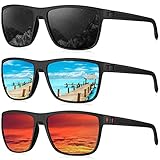
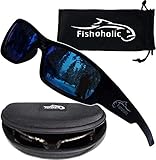
If you want a starting point rather than a specification sheet, the three pairs below are polarized, wear well under a cap or helmet, and are worth comparing on lens tint and fit.
Affiliate note: the product links below are Amazon affiliate links. As an Amazon Associate, Gent Garb earns from qualifying purchases at no extra cost to you.

Lens Types Side by Side
The quickest way to choose is to match the lens to the light you spend most of your time in, not to the frame you like best.
| Lens type | Typical transmission | What it removes | Best for | Main trade-off |
|---|---|---|---|---|
| Solid tint, category 3 | 8-18% | Overall brightness | Everyday wear, city, general driving | No effect on reflected glare |
| Polarized | 10-16% | Horizontal glare from flat surfaces | Fishing, boating, snow, highway driving | Screen and dashboard distortion |
| Gradient | 15% top to 40% bottom | Sky and overhead glare only | City wear, low sun, evening driving | Weak protection from below |
| Mirrored | Base tint minus reflectance | Extra reflected light, some heat | Altitude, open water, glacier | Visible scratches, adds no UV protection |
| Photochromic | 10-80% variable | Changes with ambient UV | Prescription wear, shifting cloud | Slow transition, useless behind glass |
A useful compromise for one-pair owners is a polarized category 2 in brown or copper. It stays usable from morning to late afternoon, handles wet roads, and does not go so dark that you have to take it off indoors.
Coatings and What Price Buys
Two lenses with the same tint and category can differ fivefold in price, and the difference is almost always coating and grinding rather than the plastic. The layers that matter are the hard coat, which resists scratching; the anti-reflective coating on the back surface; and the hydrophobic and oleophobic treatments, which make water bead and fingerprints wipe off.
Back-surface anti-reflective coating is the most underrated of the three. Without it, sunlight over your shoulder reflects off the inside of the lens and leaves a ghost image of your own eye. It is also the first coating to fail if you clean lenses with a dry shirt sleeve.
Lens thickness matters more than people expect. A 1.0 mm polycarbonate lens is light and fine in a casual frame; a 1.5 mm lens resists flexing in a wrap frame, where a thin lens pushed into a steep curve distorts your peripheral vision. If a sport frame feels swimmy at the edges, the lens is too thin for the curvature. Fogging is a separate problem, and the fix is usually airflow rather than coating, as covered in our piece on anti-fog sport sunglasses.
Common Mistakes
- Assuming dark equals protective. Tint reduces light; UV treatment blocks radiation. Check for a UV400 label, not just a dark lens.
- Buying polarized for everything. Polarized is right for water and snow and wrong for anyone who reads a dashboard or a phone all day.
- Wearing category 4 lenses while driving. Under 8 percent transmission is too dark for road signs in shadow and is restricted in several countries.
- Cleaning lenses dry. Wiping grit across a coated lens is how mirror layers and anti-reflective coatings die. Rinse first, then use a clean microfibre.
- Ignoring frame fit. A lens sitting 10 mm off your face lets light in at the sides and defeats the tint. Coverage matters as much as the VLT number.
- Leaving them on the dashboard. Heat above about 60 degrees Celsius can delaminate a mirror coating and warp a thin frame.
Frequently Asked Questions
Are polarized lenses worth it?
Yes if you spend time on water, snow or long stretches of open road, where reflected glare is the main source of discomfort. For city wear and short commutes, a good plain tint does most of the job for less.
Do mirrored lenses protect my eyes better?
No. A mirror coating reflects light and heat but adds no UV protection by itself. What protects your eyes is the UV400 rating of the lens underneath.
Can I drive with gradient lenses?
Yes, if the top of the lens handles low sun and the bottom stays light enough to read the dashboard. Avoid gradients for night driving or long trips where glare comes off wet tarmac from below.
How long do photochromic lenses last?
The photochromic molecules fade with UV exposure over roughly two to three years of daily use, and the lenses stop darkening as fully. They also will not darken inside a car, which is why they suit walking better than driving.
What is the best lens colour for fishing?
Copper or amber polarized lenses. They lift contrast on green and brown water and keep detail visible in shadow, while grey polarized lenses suit deep blue offshore water and bright open sky.