Table of Contents
When you’re launching off a 30-foot cliff on a mountain bike or dropping into Class V whitewater, the last thing you want to worry about is whether your watch can survive the experience. In 2026, shock-resistant timepieces have evolved far beyond the chunky digital blocks of decades past—they’re sophisticated instruments engineered to thrive where smartphones fear to tread. Whether you’re a dedicated extreme sports athlete or a weekend warrior pushing your limits, understanding what separates a truly shock-resistant watch from marketing hype can mean the difference between a reliable tool and an expensive piece of wrist-worn debris.
The landscape of rugged horology has transformed dramatically, with material science and micro-engineering creating watches that laugh at impacts that would destroy conventional timepieces. But here’s the thing: not all “shock-resistant” watches are created equal, and the specific demands of your chosen adrenaline fix should dictate your selection. Let’s dive deep into what makes these modern marvels tick—and what keeps them ticking when everything goes sideways.
Top 10 Shock-Resistant Watches For Men
Detailed Product Reviews
1. Casio G-Shock Shock Resistant DW5600UE-1V Men’s Water Resistant Black Resin Sport Watch

Overview: The Casio G-Shock DW5600UE-1V represents the quintessential square G-Shock that built the brand’s legendary reputation. This black resin sport watch delivers uncompromising durability in a compact, wrist-friendly 42mm case. Powered by precise quartz digital movement accurate to +/- 15 seconds monthly, it’s designed for active users who demand reliability without complexity. The watch handles recreational scuba diving with 200M water resistance while providing essential timing functions for daily training and outdoor activities.
What Makes It Stand Out: The DW5600UE-1V’s iconic square silhouette is instantly recognizable and historically significant as the original G-Shock form factor. The recessed top-left button prevents accidental setting adjustments—a thoughtful engineering detail that serious athletes appreciate during intense activities. Unlike many sport watches claiming water resistance, this model is genuinely suitable for recreational scuba diving, not just surface swimming. The multi-function alarm system offers daily, date-specific, and monthly options, providing scheduling flexibility rarely found in this price category.
Value for Money: At approximately $50-70, this watch delivers exceptional value by offering genuine G-Shock durability at an entry-level price point. You’re investing in a timepiece that often outlasts watches costing ten times more. While it lacks solar charging or atomic timekeeping of premium G-Shocks, the core shock resistance and water protection remain identical. Compared to fashion watches at similar prices, the DW5600UE-1V’s build quality and longevity make it a smarter long-term investment.
Strengths and Weaknesses: Strengths include legendary shock resistance, legitimate 200M diving certification, compact comfortable design, and month-long battery life. The button configuration prevents accidental changes during rigorous activities. Weaknesses involve the basic resin strap that can degrade after 3-5 years of heavy use, the stiff button feel that some find inconvenient, and the lack of advanced features like world time or solar power. The display is functional but not as crisp as newer LCD technologies.
Bottom Line: The DW5600UE-1V is ideal for first responders, military personnel, and outdoor enthusiasts seeking bombproof reliability without unnecessary complexity. If you want the original G-Shock experience with genuine diving capability at an accessible price, this is your watch. Skip it only if you require advanced features or prefer analog displays.
2. Timex Men’s Ironman Triathlon Endure 30 Shock 42mm Watch – Black Case with Black Resin Strap

Overview: The Timex Ironman Triathlon Endure 30 Shock positions itself as America’s answer to G-Shock dominance, bringing triathlon-specific functionality to a rugged 42mm resin package. This watch caters specifically to runners and multi-sport athletes who need detailed training data capture. With 100-hour chronograph capacity and 30-lap memory, it tracks extensive workout sessions that basic sport watches cannot. The ISO-certified shock resistance ensures survival during intense activities, while 200M water resistance handles pool swimming and surface watersports confidently.
What Makes It Stand Out: The revolutionary Indiglo backlight system illuminates the entire dial uniformly, providing superior nighttime visibility compared to typical LED backlights. The 30-lap memory function allows detailed training analysis, storing split times for comprehensive performance review. Three customizable alarm settings (daily, weekday, weekend) offer practical flexibility for varied schedules. Dual time zone functionality benefits travelers without adding complexity. The gray digital display reduces glare in bright sunlight, a thoughtful detail for outdoor athletes.
Value for Money: Priced competitively around $45-60, this Timex delivers specialized athletic features at a fraction of Garmin or Polar costs. You’re getting legitimate shock protection and advanced timing functions from a brand with 165 years of American watchmaking heritage. While it lacks G-Shock’s diving certification, it matches or exceeds everyday durability requirements. The value proposition strengthens for runners who will utilize the lap memory feature regularly.
Strengths and Weaknesses: Strengths include exceptional Indiglo illumination, robust lap memory system, intuitive button layout, and versatile alarm configurations. The acrylic lens resists shattering better than mineral glass. Weaknesses include acrylic’s scratch susceptibility, resin case that feels less premium than steel, and water resistance unsuitable for scuba diving. The display contrast is weaker than some competitors in direct sunlight.
Bottom Line: Perfect for dedicated runners, swimmers, and fitness enthusiasts who prioritize training data over diving capability. Choose this over G-Shock if lap memory and superior night visibility matter most. Avoid if you need a true dive watch or prefer maximum scratch resistance.
3. Beeasy Men’s Digital Watch with Ultra-clear Display, Waterproof, Shock-resistant, Multi-function Alarm, 5ATM

Overview: The Beeasy Men’s Digital Watch enters the market as a budget-conscious challenger to established sport watch brands, prioritizing display clarity and alarm functionality at an ultra-competitive price point. Featuring an imported EL backlit screen with exceptional brightness, this 50M water-resistant watch targets casual users and entry-level fitness enthusiasts. The ABS case and PU strap construction deliver basic shock protection for everyday activities like gym workouts and recreational swimming. With dual time, stopwatch, and countdown functions, it covers essential timing needs without overwhelming complexity.
What Makes It Stand Out: The four distinct alarm modes (daily, fixed day, fixed month, monthly) exceed what’s typically offered in budget digital watches, providing scheduling flexibility for shift workers and students. The snooze function repeats seven times at five-minute intervals—an unexpected premium feature in this segment. The ultra-clear EL backlight genuinely outperforms many entry-level competitors, offering crisp visibility in low-light conditions. At roughly $15-25, it democratizes sport watch functionality for price-sensitive buyers unwilling to compromise on core features.
Value for Money: This watch redefines budget value by delivering 80% of brand-name functionality at 30% of the cost. While it won’t match G-Shock’s legendary durability, it provides adequate protection for non-extreme activities. The five-year battery life and included customer service support enhance long-term ownership value. For users who prioritize functionality over brand prestige, the savings are substantial and justifiable.
Strengths and Weaknesses: Strengths include unbeatable price, excellent backlight clarity, versatile alarm system, and lightweight comfort. The 5ATM rating handles swimming and showering adequately. Weaknesses involve limited brand reputation, lower-grade materials that may degrade faster, restricted water resistance for serious diving, and unclear long-term reliability compared to established manufacturers. The warranty and support network cannot match Casio or Timex.
Bottom Line: Ideal for students, budget-conscious consumers, and casual athletes seeking maximum features at minimum cost. Purchase if you need functional water resistance and multiple alarms without brand premium. Avoid for professional diving, extreme sports, or status-conscious wear.
4. Casio Men’s G-Shock DW9052-1V Shock Resistant Black Resin Sport Watch

Overview: The Casio G-Shock DW9052-1V represents the round-case evolution of the G-Shock lineage, earning its reputation as a military and law enforcement favorite worldwide. This 48.5mm resin beast delivers the same 200M diving certification as its square siblings in a more traditional sport watch silhouette. The rugged construction withstands impacts that would destroy conventional timepieces, while the blue-green EL backlight with afterglow ensures readability in tactical situations. Designed for professionals who abuse their gear daily, it’s a no-nonsense tool watch that prioritizes survival over style.
What Makes It Stand Out: The flash alert system combines audible alarms with a flashing display—an invaluable feature in noisy environments where audio cues get drowned out. The afterglow backlight remains illuminated for several seconds post-activation, allowing hands-free time checks during critical tasks. The round case design appeals to traditionalists who find square watches unconventional, while maintaining identical shock protection to the legendary DW5600. Its widespread military adoption globally validates real-world durability claims beyond laboratory testing.
Value for Money: Positioned at $45-65, the DW9052-1V delivers full G-Shock protection at a price that encourages hard use without babying. You’re getting the same module durability as pricier G-Shocks, minus advanced features you’ll likely never need in harsh environments. The value proposition strengthens for military and tactical users who benefit from the flash alert feature. Compared to the DW5600, personal aesthetics become the primary decision factor.
Strengths and Weaknesses: Strengths include proven military-grade durability, legitimate scuba diving capability, excellent nighttime visibility, and the unique flash alert system. The 1/100-second stopwatch and 24-hour countdown timer cover most timing needs. Weaknesses involve significant bulk that may overwhelm smaller wrists, basic resin strap longevity concerns, and a learning curve for button functions. The display is smaller than the case suggests, creating a chunky aesthetic not everyone appreciates.
Bottom Line: Perfect for military personnel, first responders, and tactical enthusiasts who need maximum durability with traditional styling. Choose this over the DW5600 if you prefer round cases or require visual alarm alerts. Avoid for formal wear or if subtle sizing matters.
5. Casio Men’s MDV106-1AV 200M Black Dive Watch (MDV106-1A)

Overview: The Casio MDV106-1AV diverges from G-Shock’s digital dominance, offering a classic analog dive watch aesthetic with legitimate 200M water resistance at an unprecedented price point. The 44mm stainless steel case with black resin band channels professional dive watch styling without the luxury price tag. Luminous markers and hands provide essential low-light visibility, while the unidirectional anti-reverse bezel tracks immersion time safely. Powered by a reliable quartz movement with date complication at 3 o’clock, it serves users wanting traditional watch appearance with modern durability.
What Makes It Stand Out: This watch delivers true dive watch credentials—screw-down crown, 200M rating, and unidirectional bezel—for under $50, a combination that disrupts the entire entry-level dive watch category. The analog display appeals to professionals needing a watch acceptable in business casual environments while maintaining weekend dive capability. The anti-reverse bezel prevents accidental extension of dive time, a critical safety feature often missing in budget dive-style watches. Luminous application on markers and hands exceeds expectations for this price tier, providing practical nighttime functionality.
Value for Money: The MDV106-1AV redefines dive watch accessibility, offering specifications that meet ISO standards at a fraction of typical cost. You’re getting a stainless steel case, reliable quartz movement, and true diving functionality that rivals $200+ competitors. While it lacks digital convenience, the analog format transitions seamlessly from office to ocean. The value proposition centers on authentic dive watch features rather than smartwatch gimmicks.
Strengths and Weaknesses: Strengths include legitimate dive watch construction, versatile analog styling, excellent luminous performance, and stainless steel case durability. The anti-reverse bezel operates with satisfying clicks. Weaknesses involve the basic resin band that cheapens the overall feel, lack of digital timing functions for precision training, and mineral crystal that’s less scratch-resistant than sapphire. The quartz movement, while accurate, lacks the sweeping seconds hand of automatics.
Bottom Line: Ideal for watch enthusiasts seeking an authentic analog dive watch on a strict budget, or professionals needing one watch for all occasions. Choose this if you prefer traditional styling over digital functionality. Avoid if you require advanced timing features or maximum shock resistance.
6. Casio Men’s GA-100 XL Series G-Shock Quartz 200M WR Shock Resistant Watch

Overview: The GA-100 XL Series represents G-Shock’s commitment to oversized, feature-packed timepieces that dominate the wrist. This analog-digital hybrid combines traditional watch hands with a digital display, offering the best of both worlds in a brutally tough package rated for 200-meter water resistance and shock protection.
What Makes It Stand Out: The 51.2mm case commands attention while housing world time functionality across 29 time zones, five daily alarms, and a precise 1/100th-second stopwatch. The auto LED light ensures visibility in any condition, and the full auto-calendar keeps you accurate through 2099. This isn’t just a watch; it’s a tactical computer for your wrist.
Value for Money: Positioned in G-Shock’s sweet spot, the GA-100 delivers premium durability and features without reaching flagship prices. Comparable tactical watches cost twice as much while offering similar resilience. You’re investing in two decades of Casio’s R&D in shock resistance.
Strengths and Weaknesses: Strengths include unmatched durability, comprehensive features, excellent water resistance, and the versatile analog-digital display. Weaknesses: the XL sizing overwhelms smaller wrists, and battery life (approximately two years) falls short of some newer models. The busy dial may challenge readability for some users.
Bottom Line: Perfect for those who need a bombproof watch that makes a statement. The GA-100 XL excels in demanding environments while maintaining everyday wearability. If your wrist can handle the size, this G-Shock delivers legendary reliability at a reasonable price point.
7. Casio G-Shock GD100-1B | Men’s Tough Digital Watch | 200M Water Resistant | High-Brightness LED | Dual Time & 7-Year Battery

Overview: The GD100-1B targets tactical and extreme sports enthusiasts with its matte black stealth aesthetic and function-first design. This purely digital G-Shock strips away analog complications in favor of maximum readability and battery efficiency, creating a no-nonsense tool watch built for serious conditions.
What Makes It Stand Out: The revolutionary 7-year battery life sets a new standard for maintenance-free reliability. The high-brightness LED backlight with light guide plate technology delivers exceptional low-light visibility unmatched by standard electroluminescent displays. Dual time functionality and rugged shock resistance make it ideal for military and adventure use.
Value for Money: With a battery that outlasts most watches threefold, the GD100-1B offers exceptional long-term value. You’re essentially buying three standard digital watches in one, eliminating the cost and hassle of frequent battery changes while delivering professional-grade durability.
Strengths and Weaknesses: Strengths include phenomenal battery life, superior backlight visibility, 200M water resistance, and stealthy tactical design. Weaknesses: the all-digital display lacks analog sophistication, and the matte finish shows wear over time. Feature set is more limited than premium G-Shock models.
Bottom Line: The ultimate “set it and forget it” tactical watch. If you prioritize battery longevity and nighttime visibility over analog aesthetics, the GD100-1B is unbeatable. Perfect for military personnel, first responders, and outdoor enthusiasts who demand relentless reliability.
8. Casio Men’s Watch XL Series G-Shock Quartz 200M Water Resistant, Shock Resistant, Super Matte Grey Finish, Durable Resin, Men’s Wrist Watches, Digital Casio G-Shock for Men (Model GA-700UC-8ACR)
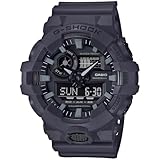
Overview: The GA-700UC-8ACR elevates the XL series with a sophisticated super matte grey finish that blends tactical functionality with contemporary style. At 52.8mm, it’s slightly larger than the GA-100, offering enhanced presence while maintaining G-Shock’s legendary toughness and 200-meter water resistance.
What Makes It Stand Out: The hand shift feature allows the analog hands to temporarily move aside, revealing the digital display underneath—a thoughtful touch for reading complications. The super matte finish resists fingerprints and reflections better than glossy alternatives, while world time and five alarms keep global travelers on schedule.
Value for Money: This model justifies its slight premium through superior aesthetics and the innovative hand shift mechanism. While the five-year battery life doesn’t match the GD100, it still outperforms standard watches. You’re paying for design refinement without sacrificing core G-Shock DNA.
Strengths and Weaknesses: Strengths include stunning matte finish, hand shift innovation, comprehensive features, and enhanced wrist presence. Weaknesses: the largest case size may be unwearable for many, and battery life is mid-range. The grey finish, while attractive, may not suit all tactical applications.
Bottom Line: For style-conscious users who refuse to compromise on durability, the GA-700UC-8ACR delivers. The hand shift feature demonstrates Casio’s attention to user experience. Choose this if you want a G-Shock that stands out visually while performing flawlessly under pressure.
9. Casio DW9052 Series | Men’s Digital Watch | G-SHOCK | Black/Black | 1/100 SEC Stop Watch | Countdown Timer | LED Light | 200M WR | Shock Resistant | Multi Alarm | Auto Calendar | Dual Time | 2 Yr Batt

Overview: The DW9052 represents the pure, unfiltered essence of G-Shock’s original digital DNA. This classic model has served military personnel and athletes for decades, offering essential functions without unnecessary complexity. Its black-on-black design maintains a low profile while delivering bulletproof reliability.
What Makes It Stand Out: The auto-calendar programmed until 2099 eliminates date adjustments for nearly eight decades—a testament to Casio’s forward-thinking engineering. The straightforward digital interface provides immediate access to stopwatch, countdown timer, and multi-alarms without learning curves. Its battle-tested design has proven itself in combat zones worldwide.
Value for Money: Often the most affordable entry into G-Shock ownership, the DW9052 delivers 90% of the durability at 50% of the cost. While the two-year battery life requires more frequent changes, the initial investment is minimal for a watch that can literally be run over by a truck and survive.
Strengths and Weaknesses: Strengths include legendary toughness, simplicity, 200M water resistance, and unbeatable price point. Weaknesses: shorter battery life, basic EL backlight (not super illuminator), and dated styling. The module lacks advanced features like world time found in newer models.
Bottom Line: The DW9052 is the smart choice for first-time G-Shock buyers or those needing a beater watch for brutal conditions. It strips away frills while preserving core toughness. If you want reliable digital functionality without financial commitment, this is your watch.
10. GOLDEN HOUR Luxury Stainless Steel Analog Digital Watches for Men Male Outdoor Sport Waterproof Big Heavy Wristwatch (Black)

Overview: The GOLDEN HOUR watch attempts to bridge the gap between luxury aesthetics and sports functionality with its stainless steel construction and analog-digital hybrid display. Unlike resin G-Shocks, this timepiece prioritizes visual presence and weight, targeting style-conscious users who want a “big heavy” wristwatch.
What Makes It Stand Out: The stainless steel design with fold-over clasp offers a more refined alternative to plastic sport watches, while the Japanese Miyota movement promises reliable timekeeping. The inclusion of tachymeter, chronograph, and dual time functions provides impressive versatility at this price point, backed by customer-friendly warranty terms.
Value for Money: Competing against entry-level G-Shocks, this watch trades ultimate durability for metal construction and luxury styling. The 30-meter water resistance significantly limits true sports use, making it more fashion accessory than tool watch. However, the warranty and materials offer decent value for desk divers and urban wearers.
Strengths and Weaknesses: Strengths include premium stainless steel build, attractive analog-digital layout, Miyota movement, and strong customer service. Critical weaknesses: only 3ATM water resistance makes it unsuitable for swimming, while unknown shock resistance questions its “sport” claims. Brand recognition lags behind Casio.
Bottom Line: Buy for style, not serious sport. The GOLDEN HOUR excels as a fashion-forward timepiece that mimics tactical aesthetics but belongs in the office, not the ocean. If you want the look of a tough watch without needing true G-Shock capabilities, this offers metallic heft and visual impact.
Understanding Shock Resistance in Modern Timepieces
What Makes a Watch Truly Shock-Resistant?
True shock resistance isn’t just about slapping a rubber bumper on a standard watch and calling it a day. At its core, it’s a holistic engineering approach that protects the movement, crystal, case, and crown from sudden acceleration forces. The magic happens in the suspension systems that isolate the movement from the case, the flexible mounting of the balance staff, and the impact-absorbing materials that dissipate energy before it reaches delicate components.
Modern shock-resistant watches employ what engineers call “de-coupling architecture”—essentially creating multiple layers of protection where the movement floats within the case rather than being rigidly fixed. Think of it like the crumple zones in a high-performance race car, designed to sacrifice outer elements to protect the critical inner mechanisms. The Incabloc and Kif systems that revolutionized mechanical watches in the mid-20th century were just the beginning; today’s solutions involve synthetic elastomers, spring-loaded mounting systems, and even magnetorheological fluids that stiffen on impact.
The Evolution of Shock Protection Technology
The journey from fragile pocket watches to modern extreme sports timepieces spans over a century, but the most dramatic advances have come in the last decade. Early shock protection focused on the balance wheel—the heart of mechanical movements—using jeweled bearings and spring-mounted settings. While effective against minor bumps, these systems were overwhelmed by the forces generated in extreme sports.
The game-changer arrived with the development of full-movement suspension systems. Rather than protecting individual components, engineers began treating the entire movement as a precious cargo requiring isolation. This shift mirrors how modern smartphones use internal frames suspended by thermoplastic urethane bumpers. Today’s cutting-edge watches take this further with adaptive systems that adjust their stiffness based on the intensity of impact, using materials that become more rigid under sudden force while remaining flexible during normal wear.
Why Extreme Sports Demand Specialized Wristwear
The Physics of Impact in High-Intensity Activities
Let’s get technical for a moment. When you catch an edge snowboarding at 40 mph and slam into hardpack, your wrist experiences deceleration forces exceeding 500G. That’s five hundred times the force of gravity concentrated on a surface area smaller than a silver dollar. A standard watch’s movement components, some weighing less than a grain of rice, can experience enough force to bend, break, or sheer completely free from their mountings.
Different sports generate different impact profiles. Mountain biking creates high-frequency, lower-amplitude vibrations that can slowly loosen components over time. Rock climbing produces sharp, directional impacts concentrated on the watch’s bezel and crystal. Motorsports combine constant high-frequency vibration with thermal cycling and magnetic fields from ignition systems. Understanding these distinct force signatures is crucial when evaluating a watch’s suitability for your specific passion.
From Mountains to Oceans: Sport-Specific Challenges
Altitude sickness isn’t the only thing that can ruin your summit attempt—temperature fluctuations from base camp to peak can cause standard watch seals to contract and expand, compromising water resistance just when you need it most. Meanwhile, saltwater corrosion attacks unprotected metal cases during extended surfing sessions, and sand particles can infiltrate crown assemblies during desert motocross events.
The best extreme sports watches anticipate these environmental assaults. They feature multiple redundant seals, chemically inert materials, and particle-exclusion systems that keep grit out of critical interfaces. Some advanced models even incorporate barometric pressure compensation systems that equalize internal pressure during rapid altitude changes, preventing seal distortion and crystal popping.
Key Shock-Resistant Technologies to Look for in 2026
Suspension Systems and IsoSpring Engineering
The buzzword you’ll hear in 2026 is “IsoSpring” engineering—though implementations vary between manufacturers. This technology mounts the movement on a floating platform suspended by microscopic springs or elastomeric dampers. Under normal conditions, the platform moves freely enough to not affect timekeeping. Under impact, the springs compress and absorb energy, preventing it from reaching the movement.
Look for watches advertising “tri-axis suspension” or “6G impact compensation.” These systems protect against forces coming from any direction, not just direct blows. The most sophisticated versions incorporate what engineers call “progressive damping”—the harder the hit, the stiffer the suspension becomes, preventing bottoming out while still absorbing maximum energy.
Case and Bezel Architecture Innovations
The external armor matters as much as internal protection. Modern shock-resistant cases use “monocoque” construction where the case back, mid-case, and bezel are machined from a single block of material, eliminating weak points at joints. You’ll also find “exoskeleton” designs where a protective cage sits proud of the main case, taking the brunt of impacts.
Bezel design has evolved beyond simple rotation for timing. Directional bezels now feature integrated shock absorbers that compress on impact, while some advanced models use “breakaway” bezels designed to sacrifice themselves to protect the crystal. The bezel attachment method is critical—screw-down bezels distribute impact forces better than snap-on or friction-fit designs.
Advanced Crystal Engineering
Sapphire crystal remains the gold standard for scratch resistance, but its brittleness has long been a weakness in extreme applications. 2026’s solutions include laminated sapphire composites where a thin sapphire layer is bonded to a more flexible polymer substrate, providing the best of both worlds. You’ll also encounter “sapphire sandwiches” with internal polymer interlayers that prevent spider-web cracking.
For ultimate impact resistance, some manufacturers have developed proprietary crystalline materials that rival sapphire’s hardness while offering significantly better shatter resistance. These often appear under brand-specific names, but the underlying technology involves aluminum oxynitride or spinel ceramics—materials borrowed from military transparent armor applications.
Material Science Breakthroughs in Durability
Carbide Ceramics and Carbon Composites
Titanium carbide and silicon carbide have revolutionized case materials for extreme sports watches. These ceramics offer hardness approaching diamond while being significantly less brittle than traditional zirconium-based ceramics. They’re produced through chemical vapor deposition, creating cases that are essentially scratch-proof and highly impact-resistant.
Carbon fiber composites have matured beyond aesthetic choices. Modern forged carbon and carbon composite cases use random fiber orientation that prevents crack propagation—when impacted, the material absorbs energy by delaminating locally rather than shattering. This “graceful failure” mode means the watch might look battered after a serious hit but remains structurally sound and functional.
Titanium Alloys and Aerospace-Grade Metals
Grade 5 titanium remains popular, but 2026 has seen the rise of beta-alloy titanium that can be hardened to 50 Rockwell C while maintaining ductility. These alloys contain vanadium and aluminum in specific ratios that create a material both lighter than steel and better at absorbing impacts without permanent deformation.
For steel lovers, 904L stainless steel—once reserved for high-end dive watches—has been joined by nitrogen-alloyed steels that offer double the impact resistance. These materials use interstitial nitrogen atoms to create a face-centered cubic structure that deforms rather than cracks under stress. The result is cases that can literally bend and spring back rather than break.
Sapphire Crystal Variants and Alternatives
While sapphire dominates the high-end market, new alternatives are challenging its supremacy. Synthetic diamond-like carbon (DLC) coatings applied to polymer crystals create surfaces nearly as hard as sapphire with vastly superior impact resistance. These hybrid crystals can survive drops that would shatter pure sapphire, making them ideal for mountaineering and climbing where altitude pressure changes increase crystal stress.
Another emerging technology uses “self-healing” polymer overlays on sapphire. These nano-coatings flow into micro-scratches when exposed to UV light, maintaining optical clarity even after abrasive contact with rock or coral. For extreme sports athletes who need to read their watch in critical situations, this clarity preservation can be life-saving.
Critical Features Beyond Shock Protection
Water Resistance Ratings Decoded
That “200M” rating on your watch doesn’t mean you can dive to 200 meters—it’s a static pressure test in laboratory conditions. For extreme sports, you need to understand dynamic pressure. Hitting water at 30 mph during a high-speed jetski jump can generate instantaneous pressures equivalent to static depths of 300+ meters.
Look for watches rated to at least ISO 6425 dive watch standards, which include condensation tests, thermal shock resistance, and strap attachment strength evaluations. For surface water sports, a minimum of 200M is non-negotiable. For diving, 300M provides a safety margin, while saturation diving requires 1000M+ ratings with helium escape valves to prevent crystal blow-off during decompression.
Magnetic Resistance for Modern Environments
Modern extreme sports often involve powerful magnetic fields. Electric mountain bike motors, avalanche beacon transmitters, and even some ski binding systems generate fields strong enough to magnetize a standard watch’s hairspring, causing it to stick to itself and run wildly fast. The best shock-resistant watches now include anti-magnetic cages made from mu-metal or similar high-permeability alloys that shunt magnetic fields around the movement.
The standard has shifted from the old “4,800 A/m” rating to modern “15,000+ Gauss” specifications. Some manufacturers have eliminated ferrous materials from the movement entirely, using silicon hairsprings and non-magnetic escapements. This “intrinsic” anti-magnetism proves more reliable than protective cages, which can be compromised by impacts that dent or deform them.
Temperature Compensation Systems
From the sub-zero cold of high-altitude mountaineering to the scorching heat of desert motocross, temperature extremes wreak havoc on watch precision. Standard quartz crystals can drift by 30 seconds per month across temperature ranges, while mechanical movements see their balance springs change elasticity.
2026’s solution involves thermo-compensated quartz movements that use dual oscillators or temperature sensors to adjust frequency in real-time. For mechanical watches, silicon components with minimal thermal coefficient of expansion maintain consistent performance from -20°C to +60°C. Some advanced models even incorporate “smart” materials in the case that actively regulate internal temperature, using phase-change materials similar to those in spacesuit insulation.
Sport-Specific Considerations
Mountaineering and Alpine Sports
High-altitude mountaineering demands watches that handle rapid pressure changes, extreme cold, and the constant risk of rock strikes. Look for watches with integrated barometric altimeters that can function without relying on GPS signals, which can be unreliable in deep valleys or near steep rock faces. The case should have minimal protrusions to prevent snagging on rope or gear, and the crown needs a screw-down design that’s operable with gloved hands.
Battery performance plummets in cold conditions, so solar-assisted movements or mechanical calibers prove superior to standard quartz. Some alpine-specific models incorporate battery-warming systems that use your body heat to maintain optimal cell temperature. The crystal should have anti-reflective coating on the inside only—external coatings can be scratched by ice crystals, creating glare when you need visibility most.
Water Sports and Deep-Diving Adventures
Surfing, kitesurfing, and whitewater kayaking subject watches to different stresses than static diving. The combination of high-velocity water impacts, sand abrasion, and UV exposure requires robust case sealing and UV-resistant materials. Screw-down crowns alone aren’t sufficient—look for models with multiple o-ring seals and crown guards that prevent accidental opening during wipeouts.
For diving, the unidirectional rotating bezel is your lifeline, but it must be secure enough to not rotate from water pressure or impact. Top-tier dive watches use ratcheting bezels that require deliberate force to turn, preventing accidental adjustment. The bezel markings should be deeply engraved and filled with luminous material that remains visible in complete darkness at depth.
Motorsports and High-Vibration Activities
The constant vibration of a motocross bike or race car engine can slowly loosen screws, fatigue metal, and degrade seals over time. Motorsport-specific watches use thread-locking compounds on all internal fasteners and feature cases with vibration-damping mounts for the movement. The chronograph pushers need to be screw-down or otherwise protected to prevent accidental activation during handlebar impacts.
Magnetic fields from ignition systems and alternators demand exceptional anti-magnetic protection—15,000 Gauss minimum. Some motorsport watches incorporate ferrofluid displays that are inherently immune to magnetic interference while providing unique timing functions. The strap should integrate with racing suits and include quick-release systems for emergency removal.
Backcountry Skiing and Snowboarding
Avalanche safety creates unique requirements. Your watch must not interfere with beacon signals, meaning minimal metal content and no magnetic shielding that could distort the beacon’s flux lines. Some backcountry-specific models incorporate emergency whistles into the buckle or have integrated inclinometers for slope angle assessment.
The watch needs to withstand impacts from ski poles, ice axes, and the inevitable yard sale crash while remaining readable in bright snow glare. Negative-display LCDs with high contrast work better than standard screens in these conditions. Temperature rating is critical—many electronic watches fail below -10°C, while mechanical watches can seize if not properly lubricated with cold-resistant oils.
Certification Standards and What They Actually Mean
ISO 1413 and Beyond: Shock Resistance Standards
The ISO 1413 standard defines the minimum requirements for shock-resistant watches: surviving a 1-meter drop onto a hardwood surface and a shock simulating a 5,000G impact delivered by a pendulum hammer. While this sounds impressive, it’s actually a baseline for everyday wear, not extreme sports.
For serious applications, look for watches tested to higher standards. Some manufacturers now test to 10,000G impacts from multiple angles, thermal cycling between -40°C and +80°C, and salt fog corrosion resistance. The most rigorous testing involves actual field use by professional athletes, with design refinements based on real-world failure analysis. These watches often carry additional certifications like “Professional Grade” or “Expedition Tested” that indicate testing beyond ISO minimums.
Military Specifications (MIL-STD) Explained
MIL-STD-810 is a series of tests covering everything from shock and vibration to altitude and humidity. However, “meets MIL-STD-810” is nearly meaningless without specifying which tests were performed and to what parameters. A watch might only pass the low-temperature storage test and still claim this certification.
More meaningful is MIL-PRF-46374, a specific specification for military wristwatches that includes 40,000-foot altitude simulation, 24-hour salt spray, and 20-foot drop tests onto concrete. Watches meeting this spec are overbuilt for most civilian applications but provide ultimate peace of mind. The newer MIL-W-50717 adds electromagnetic compatibility requirements, crucial for operations near communications equipment.
The Importance of Strap and Bracelet Engineering
Integrated Shock-Absorbing Strap Systems
The strap is your watch’s first line of defense, yet it’s often an afterthought. Advanced shock-resistant watches integrate the strap into the overall protection system using flexible mounting lugs that allow the case to “float” slightly relative to the strap. This prevents direct force transmission during impacts.
Elastomer straps have evolved beyond simple rubber. Modern fluoroelastomers (FKM) resist UV degradation, saltwater, and temperature extremes while providing optimal shock absorption. Some feature internal damping channels—hollow sections that compress on impact, extending deceleration time and reducing peak force. For alpine use, straps include avalanche beacon compatibility, using non-conductive materials that won’t interfere with signal transmission.
Quick-Release Mechanisms for Safety
In emergency situations, a watch can become a liability. Caught on rope during a climbing fall or snagged on handlebars in a crash, a watch can cause serious injury. Modern quick-release systems allow one-handed removal without tools, using button-activated spring bars that retract completely into the case.
These systems must be robust enough to not release accidentally during normal activity while remaining accessible when needed. The best designs position the release buttons on the case back, requiring deliberate pressure against a flat surface to activate. Some extreme sports watches include breakaway pins designed to fail at a specific load, sacrificing the strap to protect your wrist.
Power Reserve and Battery Life in Extreme Conditions
Solar-Assisted Movements
Battery anxiety is the last thing you need when you’re three days into a backcountry expedition. Solar-assisted quartz movements have become so efficient that even ambient light from an overcast sky can maintain a full charge. The best implementations hide solar cells behind semi-transparent dials, maintaining traditional aesthetics while providing months of power reserve.
For mechanical watches, some manufacturers have developed micro-generators that convert wrist motion into electrical energy, powering a quartz regulation system. This hybrid approach combines the soul of mechanical with the accuracy of quartz while eliminating battery changes. The generators are designed to withstand 10,000+ G impacts without damage.
Kinetic and Hybrid Power Systems
Kinetic movements, which generate electricity from a rotor like an automatic watch, have been refined for extreme sports applications. The rotors are mounted on shock-absorbing jeweled bearings, and the generating coils are potted in impact-resistant resin. These systems can store months of power in ultracapacitors that outperform traditional rechargeable batteries in cold conditions.
Some cutting-edge watches use thermoelectric generators that harvest energy from the temperature difference between your wrist and ambient air. While low-power, this trickle charge can extend battery life indefinitely in moderate climates, making it perfect for extended expeditions where every ounce counts and solar charging might be unreliable.
Digital vs. Analog: Which is Better for Impact Resistance?
Mechanical Movement Protection Strategies
The romance of mechanical movements persists in extreme sports for good reason: with proper protection, they can survive impacts that would destroy electronic components. The key is mass management—heavy rotors and balance wheels store significant kinetic energy that must be controlled. Modern shock-resistant mechanical watches use lightweight titanium components and silicon escapements that reduce moving mass by up to 60%.
The mainplate and bridges are machined from beryllium-copper alloys that flex rather than fracture, while jewel settings use spring-mounted chatons that allow slight movement under impact. Some extreme designs even incorporate a “movement cage” that completely encloses the mechanism in a protective shell within the case, creating a watch within a watch.
Digital Display Durability Factors
Digital displays have their own vulnerabilities. LCD panels can delaminate under impact, while LED backlights can fail from vibration. The best shock-resistant digital watches use “chip-on-glass” technology that bonds driver circuits directly to the display glass, eliminating fragile ribbon cables. Displays are laminated with multiple layers, including impact-absorbing polymer interlayers similar to automotive safety glass.
Touchscreen functionality, while convenient, introduces failure points. Physical buttons with sealed contacts prove more reliable in extreme conditions. If you must have touch capability, look for models that use projected capacitive technology through sapphire, allowing the touch sensor to be sealed behind an unbroken crystal surface rather than exposed at the edges.
Smart Features in Rugged Timepieces
GPS and Navigation Without Compromising Durability
Integrating GPS into shock-resistant watches presents unique challenges. The antenna must be positioned to receive satellite signals while being protected from impacts. The best implementations use ceramic bezel inserts as antenna elements, combining durability with RF transparency. Others integrate the antenna into the case back, using your wrist as a ground plane.
GPS accuracy in extreme environments requires more than just a clear view of the sky. Look for watches that combine GPS with GLONASS, Galileo, and BeiDou constellations for redundancy. Barometric altimeters and accelerometers provide dead reckoning when satellite signals are lost in canyons or dense forest. The most advanced systems use machine learning to predict GPS signal quality based on your location and movement patterns, pre-loading ephemeris data to reduce acquisition time.
Connectivity vs. Battery Trade-offs
Bluetooth and Wi-Fi connectivity enable smartphone integration but consume precious power. In extreme sports watches, these features should be selectively enabled. The best models use low-energy Bluetooth 5.2 with adaptive power control, reducing transmission strength when close to your phone to save battery.
Some manufacturers have developed “store and forward” connectivity, where data is cached on the watch and transmitted in bursts during low-activity periods. This preserves battery while ensuring your track is recorded. For emergency situations, look for watches with dedicated SOS antennas that function even when the main system is powered down, using a separate battery that can last years in standby.
Sizing and Fit for Optimal Protection
Case Diameter and Wrist Dynamics
The trend toward oversized watches actually compromises shock resistance for many athletes. A 45mm+ case extends beyond the natural protection of your wrist bones, making it more likely to take direct impacts. For extreme sports, the sweet spot is typically 42-44mm for larger wrists and 39-42mm for average wrists. The case should sit within the protective envelope of your wrist’s anatomy.
Case thickness matters too. While thin watches are fashionable, a certain thickness is required to provide adequate suspension travel for the movement. The most protective designs are 13-15mm thick, allowing 2-3mm of movement isolation space. Ultra-thin “sports” watches under 10mm often sacrifice true impact protection for aesthetics.
Lug-to-Lug Considerations for Active Wear
Long lug-to-lug distances cause the watch to overhang your wrist, creating leverage that amplifies impact forces and makes the watch more likely to catch on gear. The ideal lug-to-lug measurement is less than 50mm for most wrists, with curved lug profiles that wrap around the wrist rather than sitting flat. Some designs use articulating lugs that pivot slightly, allowing the watch to conform to wrist movement and reducing stress on the case.
For activities requiring wrist protection (like snowboarding with wrist guards), look for watches with low-profile lug designs that fit under protective gear without creating pressure points. Quick-release strap systems become essential here, allowing you to remove the watch when wearing full protective equipment and reattach it quickly during breaks.
Maintenance and Care for Longevity
Post-Activity Inspection Protocols
After any serious impact or extreme exposure, perform a systematic inspection. Check the crystal for spider-web cracks that might not be immediately visible—hold it at an angle to reflected light. Test the crown’s screw-down action; any grittiness indicates seal contamination. Press all pushers to ensure they return fully and don’t stick.
For mechanical watches, listen to the rotor winding—any grinding or irregular noise suggests bearing damage. Quartz watches should have their battery compartment inspected for moisture after water exposure, even if rated waterproof. Many failures start with minor seal compromise that progresses to total failure. A monthly inspection routine can catch issues before they become catastrophic.
Professional Servicing Intervals
Shock-resistant watches require more frequent servicing than dress watches, but less than you might think. Mechanical movements in extreme sports use should be serviced every 3-5 years, but the case sealing should be tested annually. Quartz watches need battery changes every 2-3 years, which is the perfect opportunity to replace all seals and pressure-test the case.
Don’t trust your local mall jeweler with your expedition-grade watch. Seek out authorized service centers with the proper equipment to test shock resistance after servicing. A proper service includes impact testing on a controlled drop tower to verify the suspension system hasn’t been compromised during disassembly. This costs more but ensures your watch will perform when it matters.
Price vs. Performance: Finding Your Sweet Spot
Budget Considerations for Serious Athletes
You don’t need to spend thousands for reliable shock resistance. The technology has trickled down to mid-range watches that offer 80% of the performance at 20% of the cost. Key features to prioritize: ISO 6425 certification, screw-down crown, sapphire crystal, and a proven suspension system. Avoid paying premiums for exotic materials unless your activities specifically demand them—standard titanium or steel with proper engineering beats poorly designed exotic alloys every time.
Consider the “cost per adventure” metric. A $500 watch that survives 50 extreme outings costs $10 per adventure. A $5,000 watch that survives 500 outings costs the same per use but ties up more capital. For most athletes, the sweet spot is $300-800 for quartz and $1,500-3,000 for mechanical, where you get proven durability without diminishing returns.
Investment Value in High-End Rugged Watches
Premium shock-resistant watches from established manufacturers hold value better than fashion-forward alternatives. Their technology is proven over decades, and replacement parts remain available. Some limited-edition expedition watches appreciate in value, especially those with documented use in major expeditions.
However, avoid “halo” models that prioritize precious metals or complex complications over core durability. A simple, well-executed shock-resistant watch will outlive and outperform a gold-cased tourbillon with minimal protection. The investment value comes from reliability and provenance, not ornamentation. Buy the watch that disappears on your wrist and lets you focus on your sport, not the one that screams for attention.
Future Trends in Shock-Resistant Horology
What’s Coming in 2026 and Beyond
The next frontier is adaptive shock protection using smart materials. Piezoelectric dampers that generate electricity from impacts while absorbing energy are entering production. These systems not only protect the movement but harvest energy to extend battery life. We’re also seeing the development of “self-healing” case materials with embedded microcapsules that release adhesive when cracks form, automatically repairing minor damage.
Artificial intelligence is beginning to play a role in movement protection. Micro-accelerometers detect incoming impacts and temporarily lock the movement’s most vulnerable components, similar to how a hard drive parks its heads during a fall. These systems respond in milliseconds, faster than the impact can propagate through the case. While currently limited to prototype stages, expect commercial availability by late 2026.
Frequently Asked Questions
How do I know if a watch’s shock resistance rating is legitimate or just marketing?
Look for specific certifications like ISO 1413, MIL-STD-810G (with test method details), or brand-specific testing protocols that exceed these baselines. Reputable manufacturers publish impact test results showing G-force survival and drop heights. Be wary of vague terms like “rugged” or “tough” without specific data. Independent reviews from extreme sports professionals who’ve actually tested the watch in real conditions provide the most reliable validation.
Can a shock-resistant watch still be damaged by impacts within its rating?
Yes. Ratings represent survival of a single standardized impact, not repeated abuse or impacts from unusual angles. A watch rated for 5,000G can still suffer cumulative damage from multiple 3,000G impacts. Seals can degrade, lubricants can migrate, and components can fatigue. Think of the rating as a safety net, not a challenge. Regular inspection after hard impacts is essential, even if the watch appears fine.
Do I need different shock-resistant watches for different sports?
Ideally, yes. A watch optimized for diving has features unnecessary for mountaineering and may lack critical functions like altimeters. However, a well-chosen all-around tool watch can serve multiple sports if you prioritize versatility. Look for models with modular features—GPS, compass, barometer—that can be configured for different activities. The case and shock protection system remain constant, while software adapts to your sport.
How does altitude affect a watch’s shock resistance?
Rapid altitude changes create pressure differentials that stress case seals and can cause crystals to pop if helium escape valves aren’t present. More importantly, extreme cold at altitude makes materials brittle and reduces battery output. Watches designed for high altitude include pressure-equalization systems and cold-resistant lubricants. Mechanical watches generally perform better than quartz in extreme cold, provided they use appropriate oils.
Are mechanical or quartz movements more shock-resistant?
Modern quartz movements with properly isolated circuits can survive impacts that destroy mechanical watches. However, mechanical movements have no electronics to fail from vibration fatigue. The answer depends on the specific implementation. A high-end mechanical with full movement suspension may outperform a basic quartz, but a well-protected quartz with shock-mounted circuit boards and battery contacts often provides the best overall durability. For absolute reliability in remote locations, mechanical wins—no battery to die when you’re days from civilization.
How often should I replace the seals on my shock-resistant watch?
Replace seals annually if you regularly expose the watch to saltwater, dust, or temperature extremes. For freshwater use only, every two years is sufficient. Always replace seals when changing batteries or during mechanical servicing. Seals cost pennies compared to movement replacement. Have them pressure-tested after installation—many dive shops offer this service for a nominal fee. A failed $2 o-ring can destroy a $2,000 movement.
Can I wear my shock-resistant watch during contact sports?
It depends on the sport and the watch. For martial arts or team sports like rugby, a low-profile watch with a breakaway strap is safer for you and your opponents than a bulky timepiece. Many combat sports prohibit watches entirely. For solo contact sports like boxing training, a minimal digital watch on the inside of your wrist can track rounds without becoming a weapon. Consider smart rings or other wearables for contact sports scenarios.
What’s the difference between shock resistance and vibration resistance?
Shock resistance protects against sudden, high-acceleration impacts (like dropping the watch). Vibration resistance protects against continuous, lower-amplitude oscillations (like engine vibrations) that can loosen screws and fatigue materials over time. A watch can be good at one but not the other. Motorsport watches excel at both, using thread-locking compounds and fatigue-resistant materials. Look for separate ratings if your activity involves both impact and vibration.
Do sapphire crystals really crack more easily than mineral glass?
In theory, yes—sapphire is harder but more brittle than mineral glass. In practice, modern sapphire laminates and edge-mounting systems have closed the gap. A well-mounted sapphire crystal in a shock-resistant case often outperforms mineral glass in real-world impacts because the mounting system absorbs energy before it reaches the crystal. Poorly mounted sapphire will crack where mineral glass might just scratch. The key is the complete system, not just the material.
Is it worth buying an extended warranty for an extreme sports watch?
Standard warranties typically exclude “abuse” and “extreme activities,” creating loopholes for denial of claims. Some manufacturers offer sport-specific warranties that cover impact damage, but read the fine print carefully. Third-party warranties are often worthless for extreme sports use. Instead, factor the cost of potential repair into your purchase decision. A watch from a manufacturer with a reputation for honoring warranty claims—even in gray areas—provides better value than a cheaper watch with a restrictive warranty.
See Also
- The 10 Best Shock-Resistant Watches for Men Every Adventurer Needs This Year
- 10 Best Shock-Resistant Watches for Men for Construction Workers in 2026
- 10 Best Shock-Resistant Watches for Men for Industrial Jobs in 2026
- 10 Best Shock-Resistant Watches for Men for Parkour Athletes in 2026
- 10 Best Value Shock-Resistant Watches for Men for Parkour in 2026