Table of Contents
Most men buy a belt in the same way they buy a phone charger: something functional, grabbed near the till, expected to work with everything. Then they wonder why a wide casual belt looks wrong with a suit, or why a slim dress belt disappears under a pair of jeans. The belt is one of only two or three accessories most men wear daily, and it is the one where width does the most visible work.
Width and buckle style are not taste questions, they are proportion questions. A belt has to fill the loops it passes through, balance the weight of the trouser fabric around it, and match the formality of everything else you are wearing. Get those three aligned and any belt looks deliberate.
Why Belt Width Comes First
Buckle style gets the attention, but width decides whether a belt reads as dressy, casual or workwear before anyone notices the hardware. The scale runs from about 25 mm to 40 mm, and each step changes the register.
The Width Scale in Millimeters
Dress belts sit at 25 to 30 mm (roughly 1 to 1.2 inches). They slide through slim suit loops without bunching and keep a low profile under a jacket. Casual belts run 32 to 35 mm (1.25 to 1.4 inches), the range that suits chinos, dark denim and most everyday trousers. Jeans belts start at 38 mm and go to 40 mm (1.5 to 1.6 inches), which is heavy enough to hold up denim without the belt curling at the edges.
Anything wider than 40 mm is a statement piece. It can work with heavy selvedge denim and boots, and it will look absurd with a two-button suit.
The Fill-the-Loop Rule
Measure the loop opening on your trousers, then choose a belt within about 2 mm of that measurement. A 38 mm belt in a 32 mm loop will not sit flat; it rides up at the back and creates a visible bulge under a shirt. A 28 mm belt in a 38 mm loop slides around and looks like it belongs to someone else.
On jeans, the loop is usually 40 mm deep but the fabric is thick, so a 38 mm belt sits correctly while a 35 mm belt can sag under the weight of a phone and keys.
Buckle Proportion
The buckle plate should measure close to the strap width and never more than one and a half times it. A 45 mm plaque on a 30 mm strap overwhelms the waist and pulls the eye to the middle of your body. Keep the buckle close to the belt width and let the finish do the talking.
Matching Width to Trousers
The trouser decides the belt far more than the shirt does. Fabric weight, loop height and the formality of the cut all point toward one width.
Jeans and Denim
Denim is heavy and the loops are wide, so a 38 to 40 mm belt is the natural match. A matte frame buckle in brushed steel or antique brass sits well with indigo and black denim; a polished dress buckle looks borrowed. If the jeans are distressed or heavily washed, a slightly rougher leather with visible grain fits the texture of the fabric. Our roundup of wide leather belts for denim and jeans covers the widths that actually stay flat in a 40 mm loop.
Chinos and Casual Trousers
Chinos sit between denim and tailoring. A 32 to 35 mm belt with a simple rectangular frame buckle covers office casual, weekend wear and travel without looking heavy. Cotton twill at 250 to 300 gsm has enough body to support a 35 mm strap, but a 40 mm belt will make the waistband pucker.
This is the width most men should own first, because it works with more outfits than either extreme. If you want a single belt for the working week and the weekend, these best value leather belts for work and weekend sit in that range.
Suits and Dress Trousers
Suit trousers have narrow loops, often 28 to 30 mm, and a cleaner waistband. A 28 to 30 mm belt in smooth calf with a low-profile frame buckle is the safe choice. Contrast stitching, heavy grain and oversized hardware all read as casual and will fight a worsted wool suit. For a closer look at the finish that belongs here, see these smooth leather belts for suit wearers.
If you wear suspenders or side adjusters, skip the belt entirely. A belt worn with a trouser that has no loops is a common and avoidable error.
Buckle Types and Finishes
Three buckle families cover almost everything on the market, and each one signals a different level of formality.
Frame Buckles
A frame buckle has an open rectangle or oval with a center bar and a prong. It is the most versatile shape and the only one that belongs with a suit. A slim polished frame reads formal; a thicker brushed or antique frame reads casual. A roller buckle, with a small cylinder at the bottom of the frame, reduces wear on the leather and suits jeans.
Plaque Buckles
A plaque buckle is a solid plate with a clamp or hook behind it and no visible prong. It looks modern with chinos and jeans and is a poor match for a conservative suit, where the solid plate draws the eye. Keep plaques small and unbranded.
Braided and Woven Belts
Braided leather stretches, breathes and has no fixed holes, so it adjusts in small increments. It is the right belt for summer trousers, linen and shorts, and a bad choice for jeans because the weave is not stiff enough to hold heavy denim. These braided leather belts for warm-weather outfits show how the weave density changes the look.
Hardware Color
Match metal to metal, not metal to leather. A brushed nickel buckle belongs with a steel watch and silver rings; an antique brass buckle belongs with brass hardware, tan leather and earth tones. Mixing a bright gold buckle with a steel watch is the fastest way to make an expensive outfit look assembled at random.
Our Top Picks
These three belts cover the dress, casual and denim widths described above, and each is worth comparing on strap thickness and edge finishing.
Affiliate note: the product links below are Amazon affiliate links. As an Amazon Associate, Gent Garb earns from qualifying purchases at no extra cost to you.


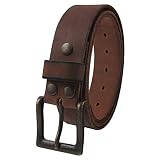
Width and Buckle Matrix
Use this as a starting point, then adjust for your own loop measurements and the formality of the occasion.
| Trouser type | Belt width | Buckle style | Leather finish | Avoid |
|---|---|---|---|---|
| Slim or skinny jeans | 35 to 38 mm | Matte frame or small plaque | Smooth or lightly distressed | Narrow dress belt |
| Straight and relaxed jeans | 38 to 40 mm | Sturdy frame or roller | Visible grain, matte | Polished dress buckle |
| Chinos | 32 to 35 mm | Simple rectangular frame | Smooth with subtle grain | Oversized plaque |
| Suit trousers | 28 to 30 mm | Slim frame, polished | Smooth calf, burnished edge | Contrast stitching, heavy grain |
| Formal evening wear | 25 to 28 mm | Low-profile frame | Box calf, no texture | Visible logos or rivets |
| Linen trousers and shorts | 30 to 32 mm | Braided or slim frame | Woven, suede or grained | Heavy 40 mm strap |
Leather Quality and Edge Finishing
Two belts at the same width can differ by years of wear, and the difference is in the hide and the edges rather than the buckle.
Grain and Thickness
Full-grain leather keeps the outer surface intact and develops a patina instead of peeling. Top-grain is sanded smooth and looks more uniform but wears faster at the buckle fold. Bonded leather, which is shredded fibers glued and rolled, will crack within a year at the holes. Strap thickness matters too: 3.5 to 4 mm suits dress belts, 4 to 4.5 mm suits casual and denim.
Edge Finishing
Painted edges are sealed with a liquid coating that can peel in heat. Burnished and waxed edges are sanded so the fibers fuse, which lasts longer. On a casual belt, a hand-burnished edge is a sign of care; on a dress belt, a thin painted edge in the same color as the leather is normal.
Matching Shoes Without Matching Perfectly
Belt and shoes should sit in the same color family, not be an identical set. Brown belt with brown shoes is enough; an exact match of leather, hardware and stitching looks bought as a package. Dark brown, mid-brown and tan are three distinct families, and the safest rule is to stay within one step of your shoes.
Fit and Sizing Checks
Most belt fit problems come from buying the trouser size instead of the belt size. They are not the same number.
How to Measure
Measure an existing belt from the fold at the buckle to the hole you use, not to the tip. That number is your belt size. If you are between sizes, round up, because leather can gain a hole but cannot gain length. A belt should fasten on the middle hole with 4 to 5 inches of tail left.
Hole Spacing and Trimming
Standard holes are spaced 1 inch apart, and a well-made belt has five. If you are consistently on the last hole, the belt is too big; on the first, it is too small. Trimming means cutting from the tip end, punching a hole and re-sealing the edge, never cutting the buckle end.
Common Mistakes
- Buying the trouser size as the belt size. Belt sizing runs about 2 inches larger than your waist measurement.
- Ignoring loop width. A belt that does not fill the loop rides up at the back and shows under a shirt.
- Wearing a plaque buckle with a suit. Solid plates read casual and pull the eye to the waist.
- Matching belt and shoes exactly. Identical sets look like a uniform; keep them in the same family instead.
- Letting the tail hang past the first loop. More than 5 inches of tail looks sloppy and catches on jackets.
- Skipping edge care. Untreated edges dry, crack and fray within a season of daily wear.
Frequently Asked Questions
What width belt goes with jeans?
A 38 to 40 mm belt is the right match for standard denim loops. Slim jeans can take a 35 mm belt, but anything under 32 mm will sag under the weight of a phone.
Should a belt match your shoes exactly?
No. Keep them in the same color family and match the hardware to your watch instead. An exact match of leather, stitching and buckle looks bought as a set.
Can I wear a wide belt with a suit?
Only if the trouser loops can take it, which is rare. Most suit trousers have loops of 28 to 30 mm, so a 38 mm belt will bunch the waistband and break the line of the jacket.
How do I find my belt size?
Measure an existing belt from the buckle fold to the hole you use most, then buy that number. If you have no belt to measure, add 2 inches to your measured waist.
Are plaque buckles formal?
No. They are a casual and smart-casual style that works with chinos and jeans. For a suit or an evening event, choose a slim frame buckle in a polished finish.